
▲作业展现场
Trans-encounters, Flux meets Fluidity
This practical course is offered by the School of Architecture, Zhejiang University, targeting students majoring in architecture and design-related disciplines. Centred on the core concept of "rooting in the cultural fabric of the ancient town and activating local creativity through reflecting, inheriting, and innovating," the two-week program will see both teachers and students based on-site at Nanxun—one of the "Six Major Water Towns in the Jiangnan Region." It guides students to transcend the boundaries of traditional classroom learning and complete a full practical cycle of "observation, perception, transformation, and creation" within a genuine historical space.
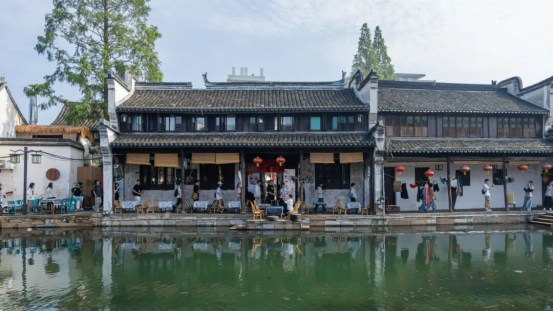

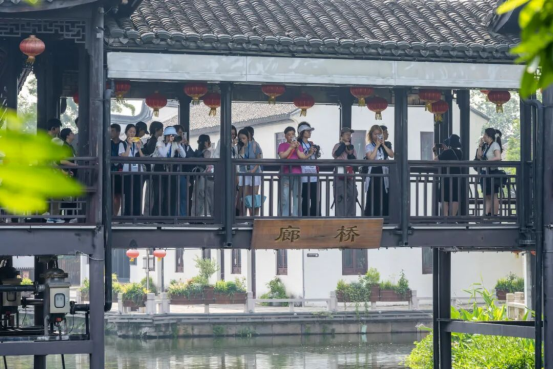

▲南浔古镇调研
课程前期以“深度调研与写生记录”为核心:第一次学生工作汇报将以小组为单位,遍历南浔古镇的核心文化场域:从张石铭故居的中西合璧砖雕门楼、刘氏梯号的巴洛克红墙,到百间楼沿水而筑的明清民居、嘉业堂藏书楼的木质书橱肌理,再到善琏湖笔厂的竹料工坊、浙丝二厂的旧缫丝机遗存。课程将引导学生用写生的方式记录古镇特质,不仅是建筑形态的速写,更需捕捉光影在青砖黛瓦上的流动、水系与街巷的共生关系、非遗工艺中的材料细节(如湖丝的光泽、湖笔竹杆的纹理),为后续创作积累“有温度的观察素材”。
In the first few days of the course, the focus is on "in-depth research and sketching documentation," culminating in the first student work presentation conducted in groups. Students will explore key cultural sites across Nanxun Ancient Town: from the Sino-Western fusion brick-carved gate tower of Zhang Shiming’s Former Residence and the Baroque-style red walls of Liu’s Tihao Mansion, to the Ming and Qing dynasty waterfront dwellings of Baijian Building and the texture of the wooden bookcases in Jiaye Hall Library. The course guides students to document the town’s unique characteristics through sketching—not merely sketching architectural forms, but also capturing the flow of light and shadow over gray tiles and cyan bricks, the symbiotic relationship between water systems and streets, and material details in intangible cultural heritage (such as the worn traces of cyan bricks, the luster of Jili Lake Silk, and the bamboo shafts of Huzhou writing brushes). This process accumulates "warm observational materials" for subsequent creation.
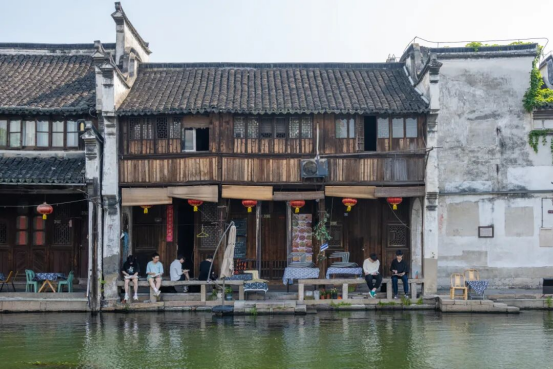

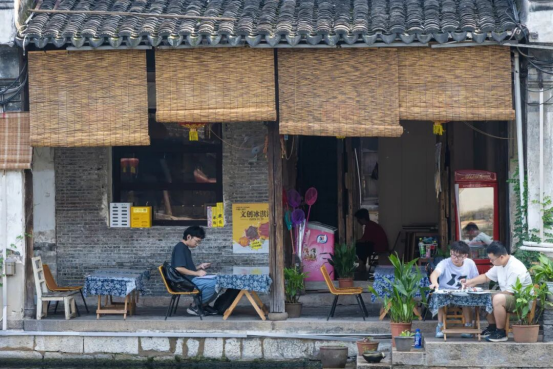

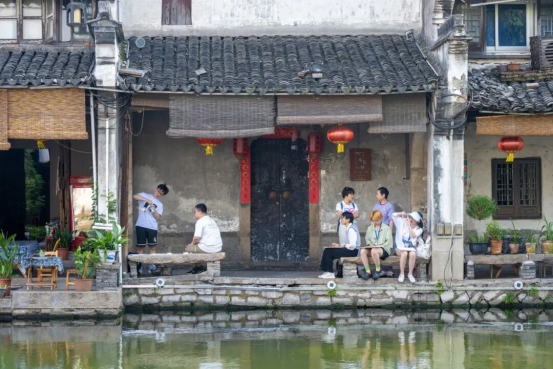

▲南浔古镇写生
课程中期聚焦“就地取材与创意转化”:学生需从古镇环境中发掘创作材料——可能是老建筑修缮时散落的青砖碎屑、河道边自然脱落的芦苇秆、湖笔厂废弃的笔毛与竹料,或是辑里湖丝的边角料、老厂房的生锈金属构件。课程不设风格与题材限制,鼓励学生结合自身擅长的媒介(如手绘、装置艺术、纤维创作、数字建模与实体打印、光影投影等),将在地材料与前期观察到的古镇特质结合:例如用青砖与树脂复刻百间楼的临水立面,用湖丝与竹篾编织嘉业堂藏书楼的窗棂纹样,或用旧金属与投影再现浙丝二厂的丝绸生产记忆,让材料本身成为“讲述古镇故事的载体”。
The middle phase of the course focuses on "on-site material sourcing and creative transformation." Students are required to collect creative materials from the town’s existing environment: these may include fragments of cyan bricks scattered during the renovation of old buildings, reed stalks naturally shed along riverbanks, discarded brush hairs and bamboo scraps from Huzhou writing brush factories, leftover pieces of Jili Lake Silk, or rusted metal components from old workshops. The course imposes no restrictions on style or theme; instead, it encourages students to combine the on-site materials with the town’s characteristics observed earlier, using media they excel in (such as hand-drawing and craftsmanship, installation art, animation, performance art, digital modeling and physical printing, or video). For example, students might replicate the waterfront facade of Baijian Building using cyan bricks and resin, weave the lattice patterns of Jiaye Hall Library’s windows with Lake Silk and bamboo strips, or recreate the silk production memories of the No. 2 Zhejiang Silk Factory using old metal and projections—allowing the materials themselves to become carriers of the ancient town’s stories.
▲课程讲座
▲课堂活动
课程后期以“作品完善与在地呈现”收尾:每位学生需完成一件聚焦南浔“单一特质”的创意艺术作品——可聚焦建筑的“中西融合”、水系的“生态灵动”、非遗的“技艺传承”,或是古镇居民的“生活肌理”。课程将在本校建筑学院的月牙楼大厅举办学生作品成果展,并邀请学校老师同学以及文化研究者来观看,参与交流,让学生的创作不仅是课程作业,更成为连接高校研究与古镇文化的对话媒介。
The final phase of the course concludes with "work refinement and exhibition presentation." Each student is required to complete an artistic work that focuses on a single characteristic of Nanxun, such as its "Sino-Western integration," the "ecological vitality of its water systems," the "inheritance of intangible cultural heritage craftsmanship," or the "daily life texture of local residents." A student work outcome exhibition will be held in the Hall of Yueya Building at the university’s School of Architecture. We sincerely invite faculty, fellow students, and cultural researchers to attend and engage in exchanges, ensuring that students’ creations are not merely course assignments, but also a medium for dialogue connecting university research with the ancient town’s culture.
▲作业指导
本课程旨在打破“创作与在地脱节”的壁垒,通过“写生记录真实、材料扎根本土、创作自主表达”的环节设计,培养学生的在地感知力、材料创新能力与自主创作思维,最终让每件作品都成为南浔古镇特质的“个性化转译”,也让学生在实践中理解“建筑与空间、文化与材料”的深层语言,和实践关联。
This course aims to break the barrier of "disconnection between creation and the local context." Through its structured design—"recording reality via sketching, grounding creation in local materials, and enabling independent expression in art"—it cultivates students’ ability to perceive local contexts, innovate with materials, and think independently in creation. Ultimately, each work becomes a "personalized interpretation" of Nanxun Ancient Town’s characteristics, while also allowing students to understand the in-depth connections between "architecture, space, culture, and materials" through practice.
▲作业展览
当转化邂逅流变
2023级建筑系南浔美术实习英文课程创作展
展 览 时 间
2025年09月24日 -10月13日
展 览 地 点
浙江大学紫金港校区
英 文 课 程 辅 导 教 师
余晓
(英国皇家艺术学院博士)
辅 导 教 师
蔡萌、赵华、邢佳萍
▲写生与课堂盲画作品
装置作品欣赏
Rough Luxury 《粗糙的奢华》胡夏瑜
I’m a little fish 《这条小鱼在乎》王滨竹
Wedding On The River 《水婚》 陆澄妍
Bamboo Spirit, Brush Soul《竹骨笔魂》江怡建
Data Skin《数据表皮》夏瑨
Memories of Baijian《浔忆百间》张云鑫
A Flora of Nanxun《南浔植物志》龚姝泽
Between Sweet and Salt: The Variations and Counterpoints of Tea Rituals《甜咸之间:茶席的变奏与复调》毛睿哲
Step on Nanxun《踏足南浔》顾长泽
The Trail of Nanxun《浔迹》陈墨涵
Rhyme of NanXun's Eaves and Fish《浔檐鱼韵》高轩
One Cup, Three Flavors · Nine Realms of Nanxun《一盏三味·九境南浔》屠舒
Traces in the wall《垣间迹》徐唯煊
Waters Converging at the Central Hall《承水明堂》刘永霖
The Xun Chronicles《浔日谈》周洋羊
Inwardness《本质》鲁沁旑
Wandering Through《穿行》郑琦
Liuhe Linglong《六合玲珑》再比热·亚森江
Nan Xun Diary《南浔日记》次仁巴姆
Floating Traces · Radiant Light《浮迹·流光》周祉言
Millenary Lantern Cord《千载灯绳》赵沁蓝
Reproducing Stone Steps of Nanxun Ancient Town《阶:南浔古镇石阶复刻》王梓丞
Wall-River《墙-河》桑珠
The book of Nanxun : Harritage unfolded《南浔之书:绵延的传承》高丽美
Unlocking the Gate of Nanxun《解锁南浔之门》陈琦龙
Window Inside and Outside《窗里窗外》姜文婕
A Continuous Thread — The Linear Translation of Nanxun's Bridge Arches《一脉相承——南浔桥洞的线性转译》吴洁
写生作品欣赏


联系我们
